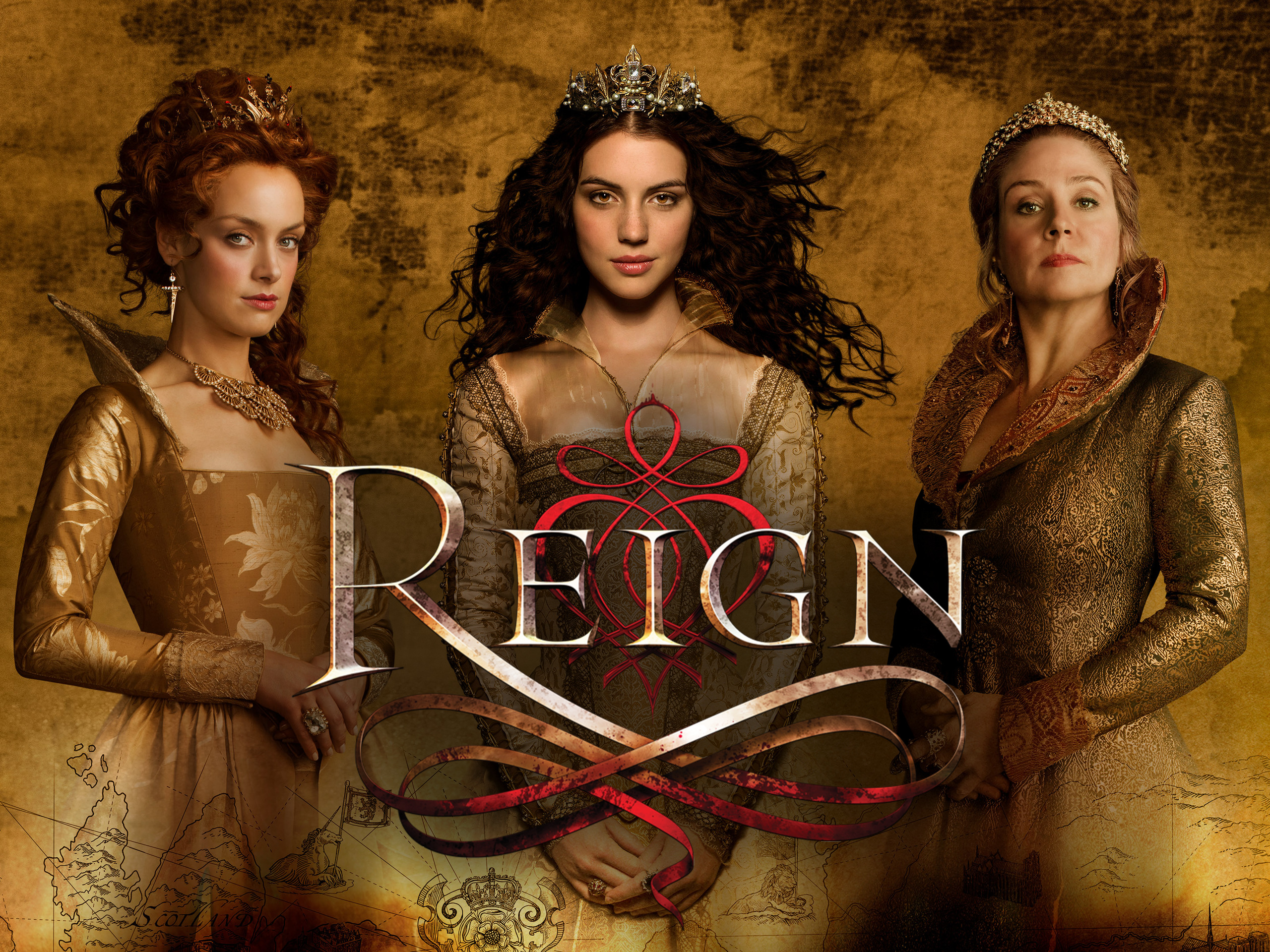
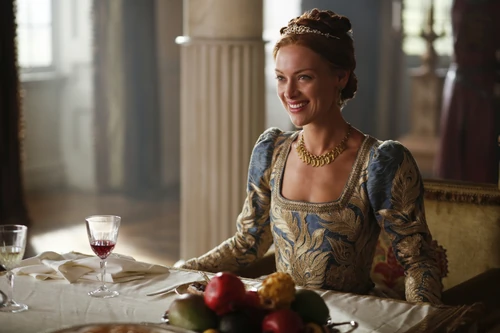
We are kicking off our more in depth look at Everything wrong with Reign (S4) with a look at the portrayal of Elizabeth I. Having been introduced as the primary antagonist in Season 3, Rachel Skarsten reprises her role in Season as an Elizabeth desperate to keep her throne.
Elizabeth’s plot lines focus on her romantic relationships and her almost paranoid defence of her throne, fearing that Mary, Queen of Scots is only ever a breath away from taking it for herself. The events of Reign bear little resemblance to anything that was going on in history at this time, and what events do draw from historical inspiration are taken vastly out of the time they happened. The show condenses about five years of history into a period of about half that, as well as slipping in events that happened well outside of this period. The Spanish Armada, for example, appears during this season almost twenty years too early while historical events, such as the English war with France, are ignored completely.
So let’s go into some of the things Reign really got wrong. Like, really wrong.
The Court of the Virgin Queen
Throughout history, the English court has been the centre of English politics and society. During the sixteenth century, the court would be packed. At the court of Elizabeth, the queen would be the centre (naturally). Around her would have been her closest friends and attendants, usually women from the nobility. Below them would have been the ladies of lesser rank, who would perform the more menial tasks for the queen, but not so menial that they were unsuitable for gentlewomen. Below them, there would be a practical army of servants making sure everything was clean and tidy, that the queen had everything she needed.
Then there was security. The queen had to be guarded, as did the court in general. There would be guards and soldiers throughout. Elizabeth could not run a country alone; she had her Privy Council, as well as advisors by the dozen, and foreign ambassadors would have rooms at court for their extended stays. Employment and success was determined by proximity to the throne, so the court would be filled with noblemen looking to catch her eye.
The palace would have its own staff, cooks, cleaners, pages, maids, but the visitors would have their own attendants. Each noble would travel with their own miniature court, not as large as Elizabeth’s but still substantial, the size of which was dependent on their rank. The court would also host entertainers, musicians, dancers, mummers, and so on. In short, the court would be an absolute hive of activity. There were so many people in attendance that they would have to move between palaces regularly so that the staff could clean the place up.
It’s why period dramas have shots filled with extras. Something which extends to Mary in Reign but does not extend to Elizabeth. Elizabeth presides over a court of one: Elizabeth. At most we see two guards, one lady in waiting, and she has one advisor at a time. She presides over a court of one; herself. She has dismissed Robert Dudley, her favourite, and William Cecil, her Secretary of State. There is no Privy Council, there are no attendants beyond the character Jane who appears in later episodes. We only see Elizabeth taking advice from Gideon Blackburn, the fictional ambassador to Scotland. When he isn’t present, it’s whichever random man has replaced him. There is simply nobody at court.
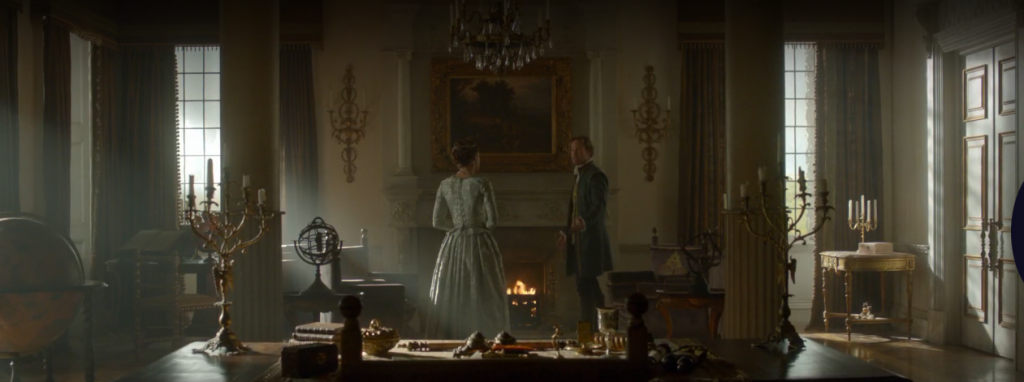
Elizabeth is entirely alone. She doesn’t even have ladies. The character of Jane appears later as maid, lady in waiting, gentlewoman of the bedchamber, and queen’s best friend all in one. Mary, by contrast, is surrounded by extras and takes advice. I don’t know what the reasoning behind this choice is. It could be to show Elizabeth as strong and independent, ruling her country entirely alone. She doesn’t need a man. She doesn’t even need advisors. But as the heroine, Mary does the opposite. She takes advice and considers the needs of her people, something which Elizabeth is entirely removed from. Elizabeth’s hold on the throne could also be seen as so tenuous that she can’t afford to surround herself with anyone. Her empty court might be a reflection of her own paranoid state. Or it might just be that the show didn’t want to pay for extras. Whatever the reason, it is wholly inaccurate. Even if the court were not the busiest place in the country, Elizabeth was always surrounded.
She didn’t even sleep alone. One of her ladies would sleep beside her and another would sleep on a pallet bed in the room. This was for her physical safety as much as the safety of her reputation. She was (theoretically at least) protected from rumours of infidelity because she was never alone. In another Elizabethan period drama, The Virgin Queen (2005) Elizabeth played by Anne-Marie Duff argues with her childhood confidante, Kat Ashley, over Robert Dudley;
“There has been no impropriety between us. God’s wounds when has there been opportunity? Do not my ladies sleep beside me? Are there not guards on my door? Am I not watched by a thousand eyes day and night?“
It’s from fiction but it accurately sums up the fact that Elizabeth would not have had a single moment of privacy. The fact that Reign’s Elizabeth is constantly and consistently alone does at least afford her that, and in the show we see her take a number of lovers which leads us neatly to…
The "Virgin Queen"
Historically, Elizabeth I may have taken lovers. It’s something I have written extensively on in my ‘Was the Virgin Queen a Virgin?‘ series. In the previous season of Reign, we see her with Robert Dudley, the most likely and famous of her lovers. This final season introduces two new lovers to the mix with some overlap; the fictional Gideon Blackburn and the equally fictional Archduke Ferdinand of Austria. I should point out that there was an Archduke Charles of Austria who was a suitor for Elizabeth at various times but he bears no resemblance to the Archduke presented in the show.
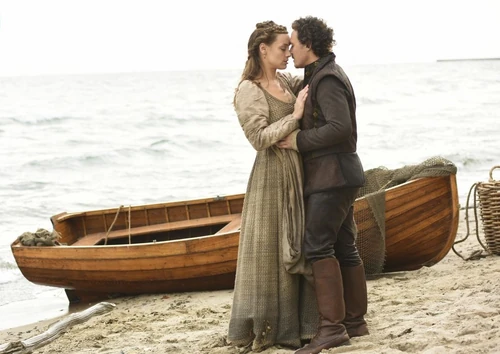
Having been ultimately rejected by Mary, Queen of Scots with whom he is desperately in love, Gideon returns to the English court, despite being the Ambassador to Scotland. He is Elizabeth’s only advisor (see the earlier note about her empty court) and eventually the two fall in love and become lovers. But in order to feel secure on the throne Elizabeth must marry elsewhere and so, she entertains a proposal from Archduke Ferdinand of Austria, whom she then also takes as her lover. Elizabeth is caught between the two men. She tells Gideon he has her heart while assuring Ferdinand that she has given up Gideon for good.
Knowing that she is going to have to marry Ferdinand, you would think that Elizabeth’s two options are to continue to see Gideon in secret, or cut him loose. Elizabeth instead chooses a secret third option; marrying Gideon! They marry knowing full well she is also going to marry Ferdinand, making her a bigamist but hey, why let that stop them? Bigamy doesn’t become an issue as Gideon dies the day after their wedding, alas and alack. Elizabeth is distraught, more so when Ferdinand tries to force through a marriage contract more beneficial for Austria. Ultimately, Elizabeth rejects him and decides to go it alone.
As Gideon and Ferdinand didn’t exist, we can easily write off their storylines. But the beauty of Reign is that so often their plotlines aren’t limited to things that didn’t happen, they fully present situations that could never have happened.
During the early years of Elizabeth’s reign, she was beset by rumours that she and Robert Dudley were lovers and/or that they had secretly married. The rumours alone were enough to destabilise England’s position on the world stage. Whatever the physical truth of the matter, Elizabeth had to be a virgin. As an unmarried woman, she was a virgin. Convention would not have allowed for anything else. It was for that reason that we can safely say that had she revealed to a potential husband that she was actually sleeping with one of her ambassadors, he would have called off the marriage immediately and denounced her. Loudly. It’s unlikely that she would have survived the scandal with her throne intact, having disgraced herself so publicly.
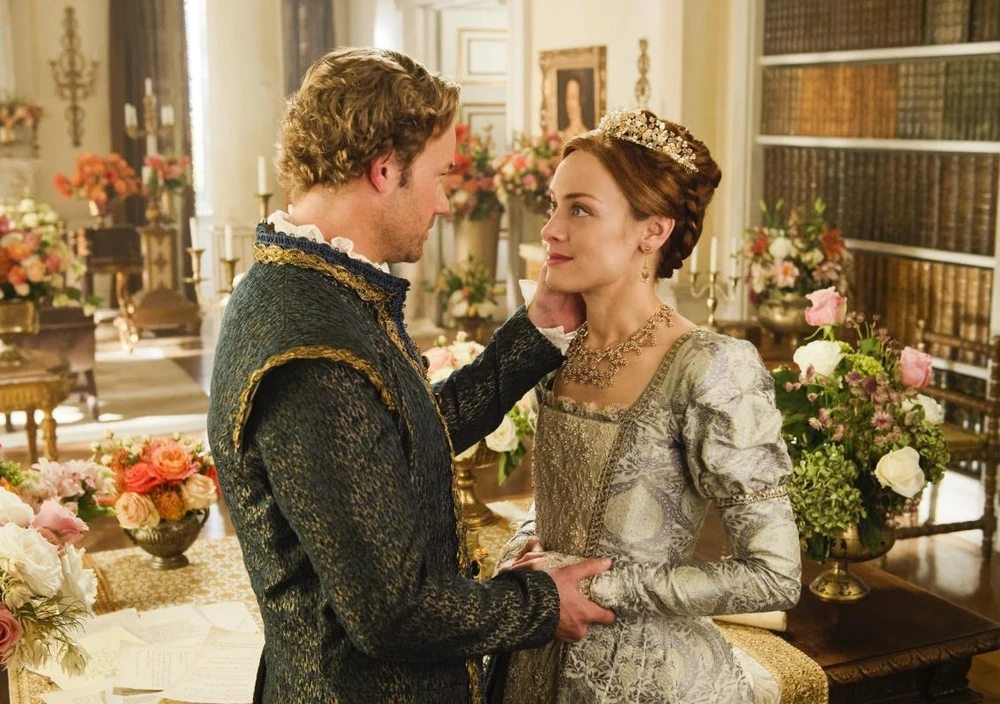
The reputation of the royals was so precarious that the historical Archduke Charles and, in fact, all but one of her suitors did not present their suits in person. It would have been the ultimate humiliation to have travelled to England, engaged in the rituals of courtly romance, only to be rejected afterwards. Humiliation that no noble let alone a royal could open themselves up to. Only one of Elizabeth’s royal suitors ever presented himself in person, Francis de Valois, the Duke of Anjou. Francis was the youngest brother of Mary’s husband, Francis. Born Hercule, he took his brother’s name after Francis’ death. He visited Elizabeth twice during their marriage negotiations, both times it was an open secret and never recognised in any official capacity. Ultimately, they didn’t marry because of the overwhelming public opposition to the match which rather than because of Elizabeth’s preference. As it happened, Elizabeth seems to have been incredibly fond of him and of all her suitors, he was the one that she seemed to consider the most seriously.
The point is that if her suitors weren’t prepared to travel to her court and face the possibility of rejection, then they would hardly go there and accept her as the lover of another man. Another thing, for a society that had such extensive marriage negotiations, the act of marriage was relatively simple. Ideally, it would happen in public with a priest and witnesses, but the Tudors of the sixteenth century absolutely recognised secret marriages. The conditions for a marriage to be considered binding were suprisingly low. All that was required for a marriage to be considered binding was for the bride and groom to commit themselves in the presence of God. But even that was a loose interpretation. An agreement to marry or an engagement could be considered as binding as a marriage itself. In the case of Catherine Howard, the fact that she and her lover Francis Dereham called each other “husband” and “wife” while sleeping together was enough to condemn them. It gave Catherine an out if she had been able to recognise it; if Catherine was already married then she could not have married Henry VIII, and therefore could not have betrayed him as she was never his wife. Longwinded but entirely legal and might have saved Catherine her head. If Elizabeth had ever engaged in a secret marriage ceremony with her lover, even one witnessed only by the two of them, it would have been as binding as if she had had a full royal wedding in Westminster Abbey with the entire country in attendance. As head of the church, she would have been absolutely aware of this and so we can safely discount the idea that she ever would. Even if we discount her personal faith which would have prevented such action, Elizabeth I refused to marry because she didn’t want to compromise her power by sharing it with a man. It’s almost impossible to imagine the same woman, who knew all to well the precariousness of her situation, risking her throne and her life by taking a lover, marrying them, having their child, or any of the above.
The Rest...
And to round off this piece, I shall briefly rundown the other things Reign depicts Elizabeth as doing that didn’t happen:
- Elizabeth did not bludgeon her maid to death with the Rod of Equity and Mercy.
- Elizabeth did not execute fifty of her nobles for meeting with John Knox. To have done so would have invited a rebellion among the nobility the likes of which had never been seen in England before, as well as leaving a power vacuum among the recently beheaded estates.
- Children weren’t allowed at Elizabeth’s court, so nobody’s daughter got to be ‘queen for the day’.
- She did not give the naval captain John Hawkins a charter to expand English interests into the Americas. Hawkins wasn’t that kind of explorer. He was one of the earliest slavers and she supported a number of his journeys.
- She also did not have a conversation with James VI of Scotland about the execution of his mother. The two never met.
There were two things shown in Reign that did happen historically. Firstly, Mary, Queen of Scots did indeed name Elizabeth I as her son’s Godmother. This was not to secure the succession but simply a tradition among royals. Elizabeth was Mary’s cousin and the nearest monarch, so it was simply an act of diplomacy to ask her. Mary also asked the Duke of Savoy, a prominent Catholic noble on the Continent, and her former brother-in-law Charles IX of France to act as godparents.
The other historical event shown in Reign is Elizabeth’s ‘Speech to the troops at Tilbury’. This was the speech Elizabeth gave to her gathered troops (at Tilbury as the name suggests) before they engaged the Spanish Armarda. It was one of her most famous and undoubtedly one of my favourite speeches in history. It is from this speech we get her iconic quote “I have the body of a weak and feeble woman but the heart and stomach of a king.”
Reign takes some liberties with the speech, it appears twenty years too early, it is condensed into a few seconds, and she is clearly in her castle and not at Tilbury but I include it here because yes, this did [nominally] happen. However, Reign‘s depiction of it is possibly the worst I have ever seen. Actually, there’s no possibly about it. It’s terrible.
For more BTS, bibliographies, and fun picking apart history, come join me on Patreon. We’re going to be talking a lot about Reign for a while.