I can’t really call this Everything Wrong With Reign Part VI, because for once, nothing included here is Reign‘s fault. They were cancelled before they got the chance to… present the story of Mary, Queen of Scots in their unique and sensational style. In the final episode of Reign, we see Mary desperately trying to protect her infant son, James, from his unstable father, Henry Stuart, Lord Darnley. Ultimately, her would-be lover, James Hepburn, the Earl of Bothwell, murders Darnley but does so with so little secrecy that he and Mary are arrested for the crime by the minister John Knox. We then cut to Mary’s execution twenty years later, at the order of her cousin, Queen Elizabeth I, while her now-adult son, James, pleads for her life.
Had Reign continued, we would no doubt have seen the historical events that led Mary from the Scottish throne to the executioner’s block. Or at least, we would have seen the CW’s interpretation of some truly dramatic historical events, as well as whatever theatrical storylines they chose to invent. I can’t speak to what they might have created, but I can cover specific events that would have made for some gripping drama as they were. So, I invite you, fellow Reign enjoyers, to consider just how unhinged the third act of Mary’s life would have been.
Mary, Queen of Nought
Reign sets Bothwell and Mary up for a tender love story. A tender love story which does not quite bear out in history. After Darnley’s death, Bothwell was accused of murder. His enemies at court, of whom there were many, moved to put him on trial for the offence but failed to secure a conviction. Leaving the court a free man, there were rumours that he would now marry the recently widowed Mary. To that end, Bothwell kidnapped the Queen and began divorce proceedings against his wife. Reign fails to mention this, but yes! Bothwell was already married! His wife, Jean Gordon, does not appear in the series. Bothwell and Mary’s story would be considerably less romantic if she did.
The circumstances of Mary’s marriage to Bothwell are continuously debated, and I have written about them in far more detail here. Whether she was a blushing bride or an unwilling participant, the fact is that a month after Bothwell’s acquittal and twelve days after his divorce, the two were married. Biographies of Mary, Queen of Scots have sometimes highlighted her occasional poor decisions. Marrying the man believed to have murdered her husband, within months of said husband’s death, was easily the most catastrophic decision Mary made in her entire life. Bothwell had assured Mary that their union had the support of the Scottish nobility, and that wasn’t a complete lie, but what support they did have disappeared in the face of the immense public backlash. The people believed that Mary’s actions proved that she and Bothwell had previously been lovers and had conspired against the late Darnley.
If Mary and Bothwell had been lovers (and there is no evidence to suggest that they actually were), the great romance came to an end almost immediately after the wedding. Bothwell had a violent temper, and some accounts suggest that, having now secured her hand, he chose to reveal to Mary that he had indeed murdered Darnley. Mary was desperately unhappy, and several witnesses recorded her suicidal ideation. Meanwhile, Bothwell had assumed the role, if not the title, of king and began conducting himself as the principal ruler of Scotland. This alienated what support they actually did have among the nobility. Those who had supported Bothwell in marrying the widowed queen, and some of those who had themselves been implicated in Darnley’s murder, now turned against him, and how.
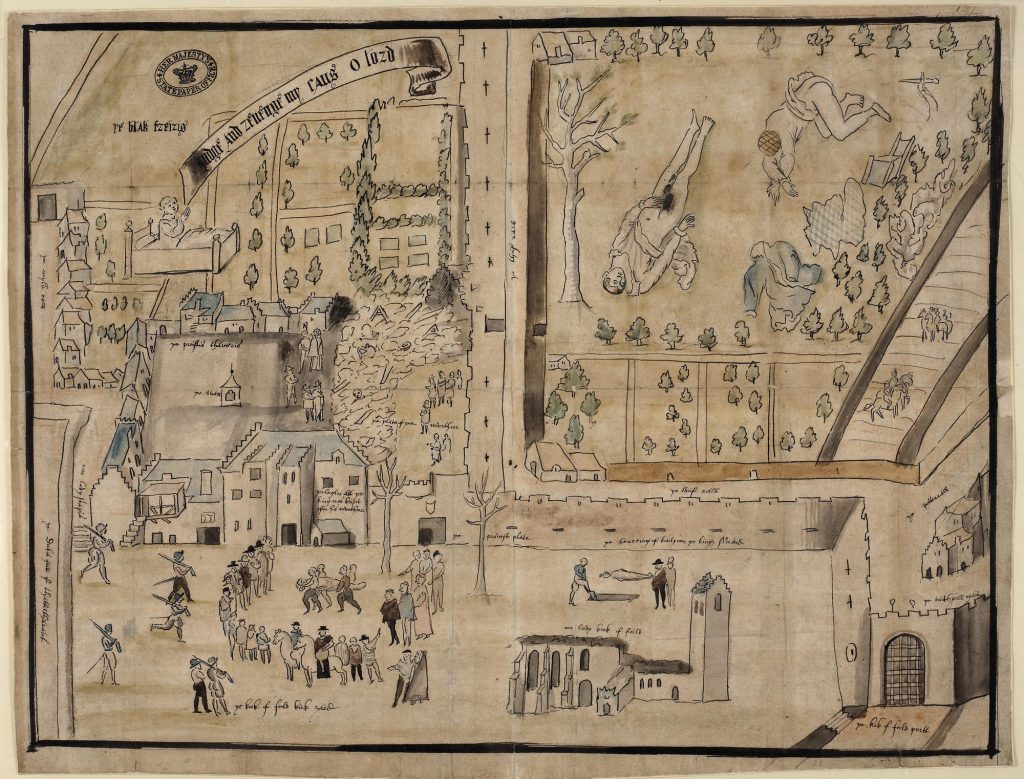
Exactly one month after their wedding, Mary and Bothwell saw each other for the last time. A group of Scottish lords, calling themselves the Confederate Lords, had raised armies and marched against them. No battle was fought. Instead, after negotiations, Mary surrendered herself to the lords while Bothwell was permitted to leave the field. Bothwell left with the intention of raising more men to their cause, but would instead, through the most bizarre twist of fate, find himself languishing in a Danish prison for the rest of his life. (More on that in tomorrow’s Patreon post.)
In the custody of the Confederate Lords, Mary saw for the first time just how far she had fallen in the estimation of her people. Previously, she had been fairly popular among the common people, but crowds now called for her death as the lords moved her between defensible locations. She was imprisoned in Lochleven Castle, but her trials were not over. A month later, Mary miscarried twins. While she was still recovering (still in the bloody bed in which she had miscarried, according to some accounts) the Confederate Lords forced her to sign documents abdicating her throne in favour of her infant son, now King James VI of Scotland.
It was almost a year before Mary was able to escape Lochleven. Disguised as a serving woman, she managed to slip out and was rowed to safety by a sympathetic supporter. From there, she declared the abdication unlawful and raised arms against her half-brother, the Earl of Moray, who was acting as regent. Mary’s forces greatly outnumbered Moray’s, but he was the better commander and, after a battle that lasted just forty-five minutes, he had completely overwhelmed Mary’s army. Against the advice of her supporters, and probably wanting to avoid another stint in prison from which she would likely not escape, Mary chose to take refuge in England. She believed that her cousin Elizabeth would help her retake her throne. Ironically, this was not an unreasonable expectation. Elizabeth did indeed oppose Mary’s abdication. Unfortunately for Mary, once she entered England, Elizabeth was forced to change tack. Mary would remain in English custody until her execution almost twenty years later.
Grim.
The Red Wedding (Reign Edition)
In the final scenes of Reign, we see an almost inexplicable moment between Catherine de Medici and her daughter Margot (Margaret). In fact, this is Margaret’s only appearance in all four seasons of the show. A prediction has been made to Catherine that after her sons fail, it will be her daughter Margaret who will bring the Valois family to power after the death of her brothers. Margaret’s wedding and the subsequent massacre (just two events that normally go hand in hand) are clearly something Reign was setting up for, and probably the only events that I am confident they were planning to portray.
The reigns of Francis II and then his brother Charles IX were dominated by the French Wars of Religion between Catholics and Huguenots (Protestants). By 1572, an uneasy peace had been negotiated between the two, but Catholics resented the King for being too lenient towards the Huguenots, while the Huguenots remained deeply suspicious of the Catholic royals. Catherine de Medici, a prominent Catholic, and Jeanne d’Albret, the most prominent Huguenot, arranged a marriage between their nineteen-year-old children: Margaret of Valois and Henri de Bourbon of Navarre. Henri, who also became King of Navarre shortly before the wedding, was also in the line of succession to the French throne, albeit after Charles IX and his brothers, Henri and Francis, not to mention any sons they might have. [Insert foreshadowing here].
The wedding went ahead on 18th August 1572 at Notre-Dame, Paris, but the opposing faiths of the bride and groom made for an unusual ceremony. Henri accompanied his bride to the doors of the cathedral but did not process inside with her. Instead, he waited outside so that he would not attend a Catholic Mass. The Pope had failed to grant the necessary dispensation, so many Catholics believed the wedding was invalid anyway. There is a later story that Margaret didn’t agree to the marriage, so her brother Charles forced her to nod her head when the moment came. This likely didn’t happen, but I include it here because the CW would have had a field day with that little historical tidbit.
Unusual circumstances aside, the wedding went ahead and was followed by days of feasting and revelry. Alas, a controversial marriage was not enough to quell the tensions between the overwhelmingly Catholic city of Paris and the visiting Huguenot leaders and Protestant nobility. During the subsequent wedding revelries, one of the guests, the Huguenot leader and advisor to Charles IX, Admiral Gaspard de Coligny, was shot and wounded. There have been centuries of speculation as to who might have ordered the assassination attempt and, for our purposes, we don’t need to go into it. (For the CW’s purposes, Catherine de Medici is a suspect, resenting Coligny’s power at court and influence over her son.) Whoever did it, the King visited the wounded Coligny and found him, and the other Huguenot nobles gathered in Paris, demanding an investigation and justice.
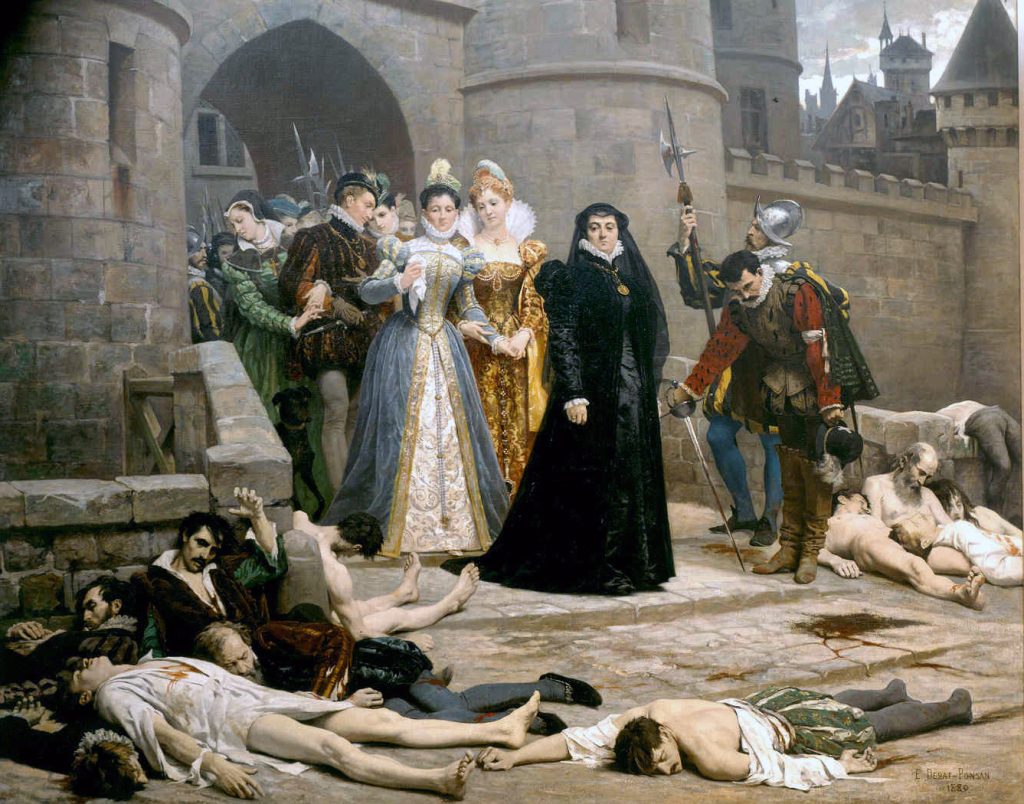
The following day, Catherine and the royal council discussed what to do about the increasingly dangerous situation. While Catherine’s culpability has also been debated at length in the intervening centuries, Charles and his council made the decision to kill a number of leading Huguenot nobles pre-emptively. To that end, the city gates were closed and royal forces were given the task of eliminating specific targets.
Around the same time, a hawthorn bush near an image of the Virgin Mary in the Cemetery of the Holy Innocents was reported to have flowered unexpectedly. Amid the violence, some Catholics interpreted this as a miraculous sign of divine approval. The predominantly Catholic people of Paris saw murder in the streets, saw a flowering bush and decided hey, God must be on our side, so they joined in.
Coligny was, ironically, one of the first to die. Chains were secured across streets and other routes to prevent Protestants escaping, and people began hunting and slaughtering their neighbours. The violence escalated and spread to other cities and provinces in France, with some believing the King himself was ordering Catholics to kill Huguenots. The death toll has never been accurately calculated. Modern estimates vary considerably, from several thousand across France to considerably higher totals, with perhaps 2,000–3,000 killed in Paris alone. Classic Catherine.
The newly married Henri remained trapped at the French court for several years and was compelled to convert to Catholicism. Still, with three Valois sons grown into men, it seemed unlikely that the Bourbon line would accede to the throne. But then Charles IX died at the age of twenty-three, less than two years after the massacre. His brother Henri became Henri III but was assassinated a little over fifteen years later at the age of thirty-seven. The third brother, Francois, Duke of Anjou, had already died of illness aged twenty-nine. With no surviving sons of the Valois line, Margaret’s husband Henri now found himself King Henri IV of France.
His marriage to Margaret had, however, not been the most successful. Both took lovers, and the two had no children together. After Henri became King of France, he and Margaret eventually negotiated an annulment, allowing him to marry Marie de Medici. He went down in history as “Good King Henry” and “Henry the Great”, which is a world away from the celebrations in the streets when the previous king, Henri de Valois, was assassinated.
Meanwhile, Elizabeth
Elizabeth I had a complicated relationship with her cousin Mary. Reign chooses to focus on and exaggerate the antagonistic elements, pitching them as mortal enemies who could only be safe when the other was dead. They weren’t quite as intent on assassinating each other as the series portrays, but their relationship definitely had its moments. That said, when Mary was forced to abdicate, Elizabeth was livid. Granted, this was almost certainly more to do with the fact that the Scottish nobility had overthrown an anointed queen than concern for Mary personally, but the result was much the same: Elizabeth strongly opposed Mary’s deposition. She refused to accept the forced abdication as legitimate and advocated for Mary’s restoration, although increasingly under negotiated conditions.
Ironically, it was Mary’s escape to England that complicated Elizabeth’s situation. For as long as Mary remained in Scotland, Elizabeth could demand her restoration from afar. Once she entered England, Elizabeth was forced to deal with the government ruling Scotland in the name of James VI, whatever her personal feelings towards its legitimacy. She tried to mediate between the two with an eye to having Mary restored, albeit under certain conditions, but this in turn forced Elizabeth to deal with the charges against the Scottish queen. Thus far, Elizabeth had managed to avoid getting involved in the whole “she might have murdered her husband and then married her accomplice” issue surrounding Mary’s abdication. She had, instead, focused on the abdication itself. Now that she was actively trying to negotiate Mary’s return to Scotland and, potentially, to the throne, Elizabeth had to address the allegations.
She held an inquiry, first in York, then in Westminster, where Mary’s half-brother, the Earl of Moray, produced the “Casket Letters”. These were a series of letters and other documents, allegedly written by Mary and kept by Bothwell, which appeared to provide evidence of their relationship and Mary’s involvement in Darnley’s murder. The authenticity and interpretation of the letters were fiercely contested at the time and remain so to this day. Ultimately, the inquiry reached no definitive verdict, which left Elizabeth in an awkward position.
She could not comfortably hand Mary over to Scotland, now governed by her enemies. Nor could she release Mary into Europe and run the risk of her attracting Catholic support against Elizabeth. She absolutely, categorically did not want to execute an anointed queen and set a dangerous precedent for herself, another anointed queen. But she could hardly allow Mary to live freely in England. Mary was the Catholic alternative to Elizabeth and possessed a strong dynastic claim to the English throne, which some Catholics regarded as superior to Elizabeth’s own. So Elizabeth did something that she would become known for: Vacillation.
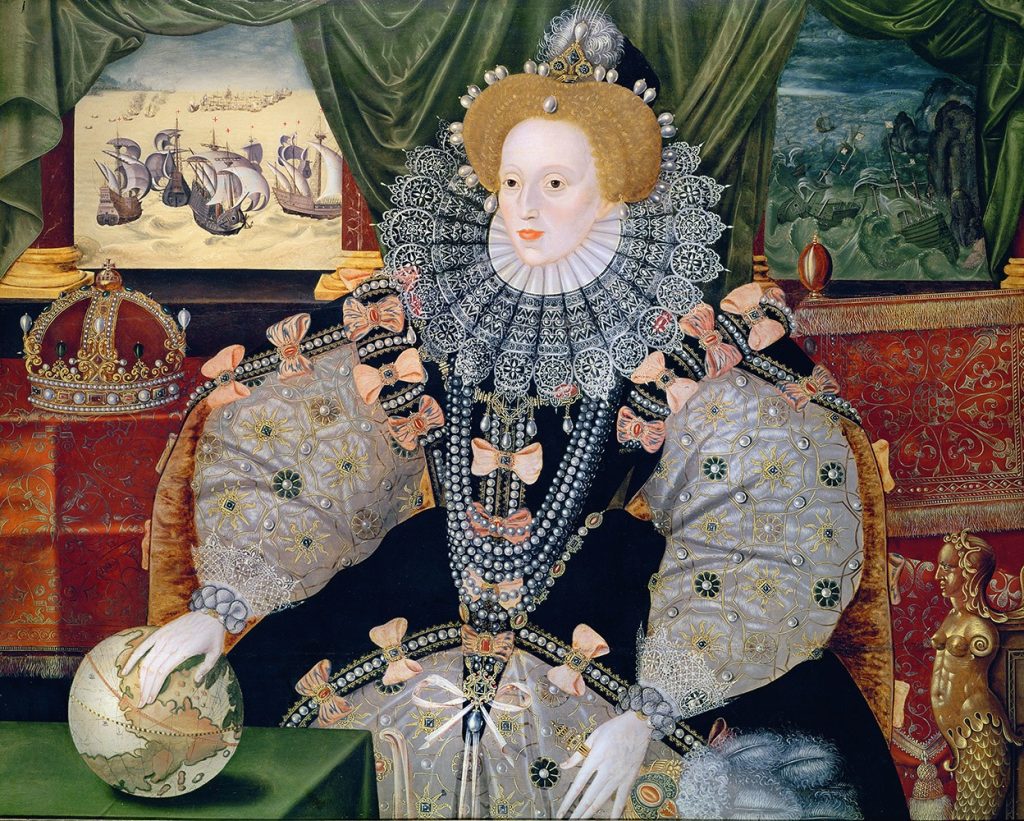
It’s important to note that the subsequent two decades of Mary’s imprisonment in England were not the result of a plan conceived when she first crossed the border. Elizabeth continued to consider ways in which the problem might be resolved, including Mary’s possible return to Scotland under negotiated conditions. None succeeded. Mary was moved between various English houses and castles, under varying degrees of confinement, and the longer she remained in England, the less reason there was for Scotland to have her back. As her son James VI grew older, he occasionally attempted negotiations that might have secured his mother’s release, but he never made her restoration a sustained objective.
When James and Elizabeth concluded the Treaty of Berwick in 1586, mention of Mary is noticeably absent. The treaty promised mutual aid if either country was attacked by a foreign power, and James received a substantial annual pension from the English crown. It didn’t declare James to be Elizabeth’s heir, something Elizabeth steadfastly refused to do, but by 1586 it was increasingly apparent that she was unlikely to marry and produce an heir of her own. In fact, her last serious foray into the marriage market had ended only a few years earlier, when she had considered marrying François, Duke of Anjou.
But wait, I pretend to hear you cry, wasn’t François, Duke of Anjou, a Valois? Yes. Yes, he was. He was Catherine de Medici’s youngest son. Born Hercule, he later took the name François in honour of his deceased brother, Mary’s first husband, Francis II. Anjou travelled to England, the only one of Elizabeth’s foreign suitors to ever do so, and the two appeared to be genuinely taken with each other. Imagine, if you would, Reign having to portray Elizabeth’s courtship of Mary’s former brother-in-law, fully supported by Catherine de Medici, while Mary is imprisoned in an English castle. The drama doesn’t need exaggerating, which is why it’s hilarious to imagine just how much it would be exaggerated.
Despite Elizabeth and Anjou’s apparent inclination towards the marriage, it was not to be. Opposition in England was fierce, particularly because Anjou was both French and Catholic, and the proposed marriage ultimately came to nothing. Anjou departed and died in 1584, aged twenty-nine, after a spectacularly unsuccessful military campaign in the Netherlands.
With no prospect of children on the horizon, James was the obvious eventual successor, even though Mary was still alive. If Mary returned to Scotland, James would have to figure out a role for her that didn’t diminish his own position, whereas if he remained on good terms with Elizabeth, he strengthened his prospects of eventually inheriting England and uniting the crowns. Again, the things Reign could do with such calculation.
The Path to the Executioner's Block
As if to illustrate just how dangerous Mary’s presence could be, the year after she became Elizabeth’s reluctant prisoner there was a rebellion by the Northern Earls of England. The rebels sought to restore Catholicism and free Mary, possibly marrying her to the Duke of Norfolk in the process to strengthen her English claim. Although Mary was not directly responsible for the rebellion, it confirmed that she could become a focal point of English Catholic disaffection. A couple of years later, Mary was more directly linked to the Ridolfi Plot, which would have seen a Spanish-backed invasion overthrow Elizabeth and place Mary upon the throne, where she would marry the Duke of Norfolk. The fallout from this plot would reveal just how much Elizabeth didn’t want to execute Mary. In the aftermath, the Duke of Norfolk, the premier duke in the country and another of Elizabeth’s cousins, was executed, but Mary was not. Even when Elizabeth was pressed to take action against Mary, she refused.
This would prove to be a pattern during Mary’s imprisonment in England, though her involvement in the plots that centred around her was varied and often difficult to prove explicitly. Elizabeth repeatedly resisted demands for more drastic action against her cousin. In 1586, however, Mary was directly and personally implicated in the Babington Plot, which would have (surprise, surprise) assassinated Elizabeth and instigated a Catholic uprising. With Mary’s own intercepted correspondence before them, Elizabeth’s government finally had evidence that could be used against her under legislation passed the previous year specifically to protect the Queen against conspiracies undertaken on behalf of a rival claimant. Even after Mary was tried and found guilty, Elizabeth resisted calls for her execution. Parliament petitioned her to carry out the sentence, but the Queen remained deeply reluctant.
Eventually, Elizabeth did sign Mary’s death warrant but the circumstances are murky, to say the least. The warrant was entrusted to one of her secretary’s who was apparently told to hold onto it for now. Instead, it found it’s way to the Privy Council who immediately enacted it, unbeknownst to Elizabeth. After Mary’s execution, Elizabeth furiously maintained that she had not intended for the warrant to be carried out when it was the secretary became the perfect scapegoat. Contemporaries and historians have been debating whether this was a genuine reaction or simply an exercise in plausible deniability ever since.
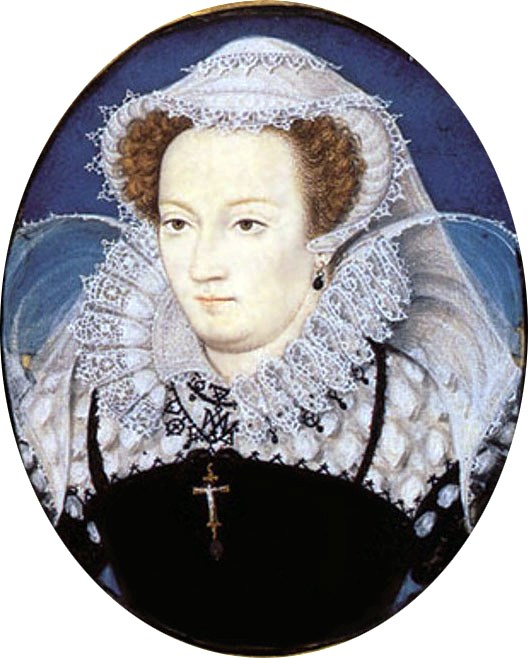
Mary’s son, James, did not personally intervene a la Reign. While his mother was on trial, he did dispatch an ambassador to England to petition against the death penalty. He did not, however, take any meaningful action after the fact.
The execution itself was pretty brutal, even by the standards of an execution. While Reign‘s finale does show Mary’s final moments, it happens too quickly to carry any emotional weight and has no build-up whatsoever, which is probably why they don’t choose to exploit the moment for maximum drama. Historically, as Mary arrived at the block, she removed her outer garments to dramatically reveal clothes of crimson; the colour of Catholic martyrdom. The executioner brought down the axe but missed her neck, striking the back of her head instead. To the horror of those gathered, a second stroke still failed to sever her head completely, and the executioner had to finish the job. As was tradition, he took her decapitated head by the hair to present it to the crowd, only for the hair to come away in his hand and the head to fall. Mary had been wearing a wig. There was further consternation when her body seemed to move beneath its clothes, only for her small dog, which had apparently hidden itself there, to emerge.
I actually think that Reign, even with more time and opportunity, would have given Mary a far more dignified end than she actually suffered, which, considering some of the situations they put her in, is saying something.
If you have enjoyed this post and would like to support my work, you can find me on Patreon. This week, I will be discussing just what happened to the Earl of Bothwell, and looking at the memoirs of Queen Margot herself, as well as behind the scenes research. You can also join me there to suggest what other historical fictions to tackle next.